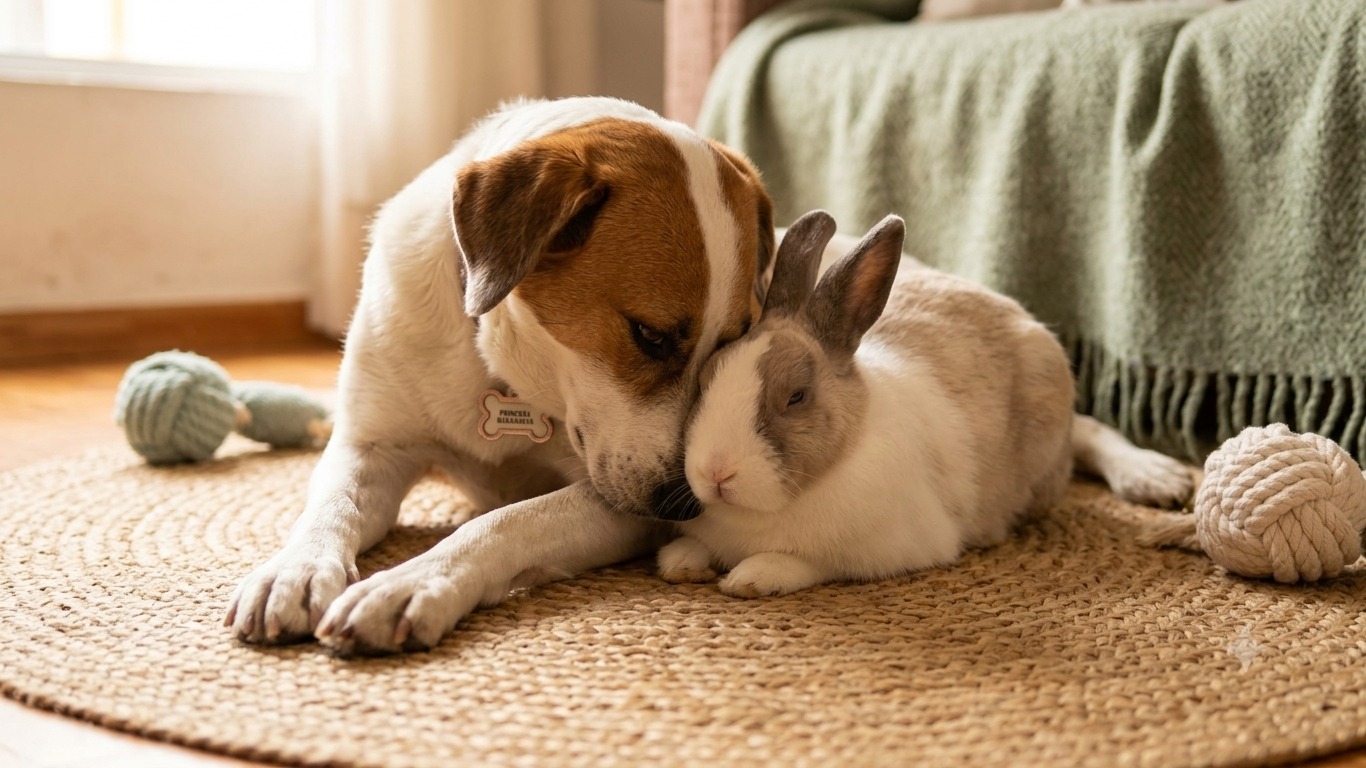
Plenty of owners have watched a dog and a rabbit share a living room without incident and assumed the arrangement was working. The problem is that “no visible problem yet” is not the same thing as a stable, low-risk relationship. Rabbits are prey animals. Dogs are predators. Those instincts do not disappear just because both animals live under the same roof and eat from the same grocery budget.
The real question is not whether a dog and a rabbit can occupy the same house. The question is whether they can do so without the rabbit living in a state of chronic stress or facing a sudden, irreversible accident. The answer depends far more on the individual animals and the owner’s daily management than on any general rule about species compatibility.
Why Prey Drive Matters More Than a Friendly Personality
A dog that is gentle with people or other dogs can still have a strong prey drive. Prey drive is not the same as aggression. It is the instinctive sequence of orienting, stalking, chasing, and sometimes grabbing that many dogs show toward small, fast-moving animals. A rabbit that suddenly darts across the floor can trigger that sequence even in a dog that has never shown hostility before.
Owners often misread a dog that stares intently, freezes, or becomes unusually still around a rabbit. That stillness is not always calm interest. It can be the start of the chase sequence. A dog that has learned to ignore a rabbit while the rabbit is sitting still may still react if the rabbit hops, thumps, or flees. Once the chase begins, the size and speed difference make serious injury or death a realistic risk.
Breed tendencies exist, but they are only starting points. Many terriers, sighthounds, and herding dogs have elevated interest in small animals. Plenty of mixed-breed dogs do as well. Individual history and training matter more than the label on the pedigree. A dog that has never been exposed to rabbits may react more strongly the first time one appears than a dog that has been carefully desensitized.
What the Rabbit Experiences That Owners Often Miss
Rabbits do not always show fear the way people expect. Some freeze. Some become unusually quiet. Some stop eating or stop using the litter box for short periods. Others thump, hide for long stretches, or show increased aggression toward people or objects. These are stress responses, not personality quirks.
Even when a rabbit appears to “accept” a dog’s presence, the rabbit may still experience elevated stress hormones. Chronic low-level stress can affect digestion, immune function, and behavior over time. A rabbit that never gets a true break from the dog’s presence may never fully settle. That is one reason many experienced rabbit keepers insist on a fully secure, dog-proof space that the rabbit can access at all times, including overnight.
Rabbits also have different social and territorial needs. They are not simply small dogs that happen to eat hay. Their body language, communication, and preferred environment are distinct. Expecting a rabbit to adapt to a dog’s social style usually places the heavier burden on the prey animal.
When Coexistence Can Work—and When It Usually Doesn’t
Some households do manage to keep dogs and rabbits under the same roof without constant crisis. The cases that succeed tend to share several features:
- The dog has a low or well-managed prey drive and has been carefully introduced under controlled conditions.
- The rabbit has a completely secure living area the dog cannot enter, with solid barriers rather than flimsy gates the dog can push or jump.
- Interactions, when they occur, are short, supervised, and end before either animal shows rising arousal.
- The owner is realistic about never leaving the two unsupervised, even for a few minutes.
- Both animals have enough enrichment, exercise, and rest that boredom or frustration does not raise the stakes of every encounter.
Success is less common when the dog has a history of chasing wildlife, when the rabbit is free-roaming without a safe retreat, or when the owner hopes the animals will simply “get used to each other.” Getting used to each other is not a reliable safety plan when one animal can kill the other in seconds.
Puppies and young dogs introduce another complication. A playful puppy can overwhelm a rabbit even without strong prey drive. As the dog matures, its interest in the rabbit may increase rather than fade. Early tolerance does not guarantee lifelong compatibility.
How to Approach Introductions Without Creating False Confidence
If an owner decides to attempt shared living, the process should be slow and structured. Start with scent swapping and visual contact through a solid barrier. Watch the dog for intense staring, stiff posture, whining, or attempts to push past the barrier. Watch the rabbit for freezing, thumping, hiding, or refusal to move normally.
Only after repeated calm responses should any closer contact be considered—and even then, the rabbit should have an immediate escape route the dog cannot follow. Keep sessions short. End them while both animals are still relaxed. Never use food to lure a rabbit toward a dog or force proximity for photos.
Many owners skip straight to “they met and nothing bad happened.” That single data point tells very little about what will happen the first time the rabbit runs or the first time the dog is left alone with the opportunity. A history of uneventful short meetings is not the same as a proven safe relationship.
Practical Management That Actually Reduces Risk
Secure housing for the rabbit is non-negotiable. A free-roaming rabbit in a house with a free-roaming dog requires constant vigilance that most households cannot sustain. A solid enclosure, a closed room with a sturdy door the dog cannot open, or a combination of both gives the rabbit recovery time and removes the chance of an accidental encounter.
Supervise every interaction. “Supervise” means active attention, not simply being in the same room while scrolling a phone. Have a plan for interrupting the dog if arousal rises—calling the dog away, using a leash, or ending the session. Do not rely on verbal corrections once a chase has started; prevention is far more reliable than interruption.
Watch for changes over time. A dog that was previously indifferent can develop stronger interest after a rabbit reaches adolescence, after a move, after a period of reduced exercise, or after the dog practices chasing other small animals outdoors. Reassess regularly rather than assuming the early pattern will hold forever.
If either animal shows persistent stress, escalating interest, or any near-miss incident, increase separation rather than trying harder to force coexistence. The goal is not to prove that the animals can share space. The goal is to keep both animals physically and psychologically safe.
When Professional Help or a Different Arrangement Makes Sense
Some situations benefit from guidance from a qualified professional who understands both species—someone experienced with dog behavior and rabbit welfare. This is particularly true if the dog has a known high prey drive, if previous introductions produced strong reactions, or if the household includes multiple dogs or free-roaming rabbits.
In other cases, the most responsible choice is permanent separation of living spaces or the recognition that the two animals should not share a home at all. That decision is not a failure. It is an acknowledgment of biology and individual temperament. Rabbits can live full, enriched lives without ever interacting with a dog. Dogs can live full lives without access to a rabbit.
The Real Measure of Success
A peaceful household is not defined by how often the dog and rabbit can be photographed side by side. It is defined by whether the rabbit can move, eat, rest, and explore without chronic fear, and whether the dog is not repeatedly placed in situations that trigger strong predatory responses.
Some pairs manage a careful, supervised coexistence. Many more do better with clear physical boundaries and limited or no direct contact. The owners who protect both animals are the ones who treat instinct as real, supervision as mandatory, and separation as a legitimate tool rather than a last resort.
If the arrangement requires constant tension management, repeated close calls, or a rabbit that never fully relaxes, the kindest adjustment is more space—not more hope that the next interaction will finally prove everything is fine.